
Executive summary.
FM outsourcing succeeds when the client and service provider give the human side of the relationship the same care and attention they give to the technical and commercial elements of the agreement. Scope, cost, service levels, and compliance establish the operating baseline, but day-to-day performance depends on how leaders communicate, make decisions, resolve issues, and maintain stakeholder confidence.
For large occupiers, weak relationship management degrades service quality, increases cost through rework, shadow FM activity, and poorly managed local variation, slows decisions, weakens operational resilience, and reduces confidence among site leaders, business users, and provider teams.
The effort required to manage that relationship has become more important as FM portfolios have become larger, more distributed, more data-enabled, and more dependent on coordinated delivery across client teams, provider teams, subcontractors, technology platforms, and local stakeholders. Dashboards and analytics can improve visibility, but they do not replace judgment, clear decision-making, or direct communication.
Effective outsourcing relationships are not free of service issues. They are distinguished by how well the parties work together to understand what is actually happening and solve the right problems. That requires a mutual assumption of good intent, a shared commitment to the business outcome, and a blameless effort to understand the underlying facts before deciding what should change.
When the client and provider create those conditions, the relationship can move from symptoms to root cause, from endless debate to practical resolutions, and from a relationship that demoralizes and struggles to one that elevates and performs.
Introduction.
FM services are challenging to deliver consistently because the work is local, physical, and people-dependent. Services are performed at the site level, often by teams assembled specifically for the account, in environments with different buildings, stakeholders, operating pressures, and business expectations. Unlike more centralized or automated business services, FM performance is experienced directly by occupants, site leaders, and business users every day.
As a result, service issues, perception gaps, and stakeholder concerns are inevitable, even in the best-managed accounts. After transition, the test of the outsourcing relationship is not whether problems occur. The test is whether the client and provider can develop a shared understanding of what is happening, constructively solve the right problems, and confidently prevent avoidable recurrences.
FM outsourcing should therefore be managed as a shared operating relationship, not only as a contract administration or reporting process. The contract establishes the rules, but the working relationship determines whether the parties can interpret expectations, address variation, resolve service gaps, make decisions, and maintain confidence in the operating model.
This is not an argument for more meetings, reporting, or oversight. It is an argument for better relationship management: the practical habits that help client and provider teams understand issues accurately, make decisions at the right level, and follow through on the actions needed to sustain performance.
Why outsourcing relationships break down.
FM outsourcing relationships usually weaken for one of three reasons.
First, service delivery may not meet the actual needs of the business. This is the most important diagnostic issue in FM outsourcing because the same symptom can have several causes. A stakeholder may say, “the service is not good enough,” but that concern may reflect provider performance, contract interpretation, incomplete reporting, poorly managed local variation, or a real change in business need.
These causes often overlap. The provider may be delivering most services as intended, while also missing certain handoffs. The contract may be directionally clear but leaves room for interpretation. Stakeholders may expect a higher level of responsiveness than the commercial model supports. Metrics may show compliance while failing to capture the condition, timing, communication, or user experience that matters locally.
For that reason, the remedy is rarely as simple as “enforce the contract” or “change the scope.” The parties must first understand the fact pattern. If the provider is not delivering to the agreed standard, the remedy is performance correction. If the standard is unclear, the remedy is interpretation and alignment. If the business need has changed or was not fully understood, the remedy may involve a service delivery decision about the service model, staffing, response standards, funding, or site-level variations.
Second, stakeholders may believe the service is underperforming even when reported metrics suggest compliance. This often occurs because reporting does not always measure what the parties assume it measures. Data may be filtered, incomplete, delayed, or focused on activity rather than outcome. A report may confirm that a work order was closed without indicating whether the issue was resolved, whether the user was notified, or whether the same problem recurs.
Third, the client may lack confidence in the provider’s ability to manage risk, respond to issues, or operate independently. In these cases, the problem is not only performance. It is also trust, change management, stakeholder experience, and perceived control.
These issues require different responses. Treating every concern as a contract compliance matter can damage the relationship. A more useful approach requires patience, practical judgment, and enough engagement with the facts to determine whether the lasting solution is corrective action, expectation alignment, data clarification, service redesign, or a business decision.
Two dimensions of relationship performance.
Two dimensions carry most of the weight in an FM outsourcing relationship.
Service delivery
The provider must deliver the required services reliably, safely, and consistently. The client must clearly define expectations, make required decisions, and avoid poorly or inconsistently managed local variation.
Business relationship management
Both parties must maintain the working relationship that allows issues to be raised early, decisions to be made efficiently, and stakeholders to remain confident in the operating model.
These dimensions are connected. Service problems become relationship problems when expectations are unclear, facts are disputed, concerns are not heard, or commitments are not closed. Relationship problems appear as service problems when stakeholders lose confidence, communications feel opaque, or local leaders believe their needs are not understood.
The goal is not to avoid disagreement. The goal is to create a relationship in which concerns can be raised early, discussed objectively, and resolved without unnecessary defensiveness or blame.
Service delivery diagnostics.
A useful diagnostic review begins with four questions:
Is the service being delivered?
Is the provider performing reliably against agreed requirements?
Is the service properly defined?
Does the service model fit the actual needs of the business, site, or operating environment?
Is performance being understood?
Do the data, reporting, stakeholder feedback, and local operating experience tell the same story?
Is the model trusted?
Do stakeholders believe the provider can manage risk, respond to issues, and operate with the right level of autonomy?
These questions help the parties avoid treating every issue as a simple performance failure. They also create a practical path from concern to facts, to decision, to action.
1. Service delivery falls short of business requirements.
The first diagnostic question is whether the concern reflects a delivery failure, a service-design gap, an interpretation issue, or some combination of the three.
In some cases, the contract defines the required standard, but the provider does not consistently deliver. In other cases, the provider may be meeting the apparent contract requirement, while the business experiences a legitimate operating gap. In still other cases, the contract, reporting, and stakeholder expectations may be sending conflicting signals about what is actually required.
The stakeholder experience may feel similar in each case: the service does not feel sufficient. The correct responses to these situations are very different, and getting the response wrong can provoke frustration for client and provider alike. A delivery failure requires performance correction. An unclear standard requires interpretation and alignment. A service-design gap requires a business decision about scope, staffing, service levels, funding, or acceptable variation across sites.
Confusing these situations can create frustration on both sides. The client may press the provider harder against a standard that does not fully address the business need. The provider may defend contractual compliance while stakeholders continue to experience a real operating problem. Local stakeholders may also seek informal workarounds that bend the commercial model without creating a clear decision about funding, priority, or accountability.
For example, a site leader may report that reactive maintenance is “always slow,” while the dashboard shows response-time compliance. A closer review may show that technicians acknowledge work orders on time, but resolution is delayed by parts availability, unclear handoffs, or poor communication back to requestors. The issue is not simply whether the SLA was met. It may involve service design, reporting scope, communication, and stakeholder confidence.
A relationship-oriented response should clarify four points:
- Contract requirement: What does the agreement require, and where is interpretation needed?
- Operating intent: What outcome was the service model intended to support?
- Stakeholder need: What does the local business believe it needs, and why?
- Service delivery decision: Is the gap a performance issue, a communication issue, a data issue, or a service-model issue that may require a change to the service delivery approach, service standard, or commercial arrangement?
Local teams often experience service issues as urgent. Some requests for exceptions or site-specific standards may reflect legitimate business need. Others may reflect preference, habit, perceived urgency, or misunderstanding of the commercial model.
The right response is not to reject variation reflexively or approve every request. Leaders should determine whether the site is identifying a real operational gap, whether the need is temporary or structural, whether the current data supports the concern, and whether the enterprise is prepared to fund and actively manage a higher standard.
When a real service failure occurs, the response should focus on root cause, prevention, and follow-through. The most useful question is not only “who failed?” but “what allowed the issue to occur, and what needs to change so it does not repeat?”
That approach supports honest discussion without weakening accountability.
2. Stakeholders believe service falls short of the contract.
Perception gaps are one of the most common sources of tension in FM outsourcing. A stakeholder may believe performance is poor even when the account is meeting reported service levels. In other cases, the stakeholder may have noticed a legitimate issue before formal reporting captures it.
The provider should not dismiss perception as unsupported by the data. The concern should be taken seriously and reviewed fairly. Stakeholder perception is part of the account’s operating reality, especially when the stakeholder is responsible for business continuity, employee experience, customer experience, or site leadership.
As seen in the graphic below, there can be a number of reasons for these “perception gaps,” and they require a little finesse to resolve.
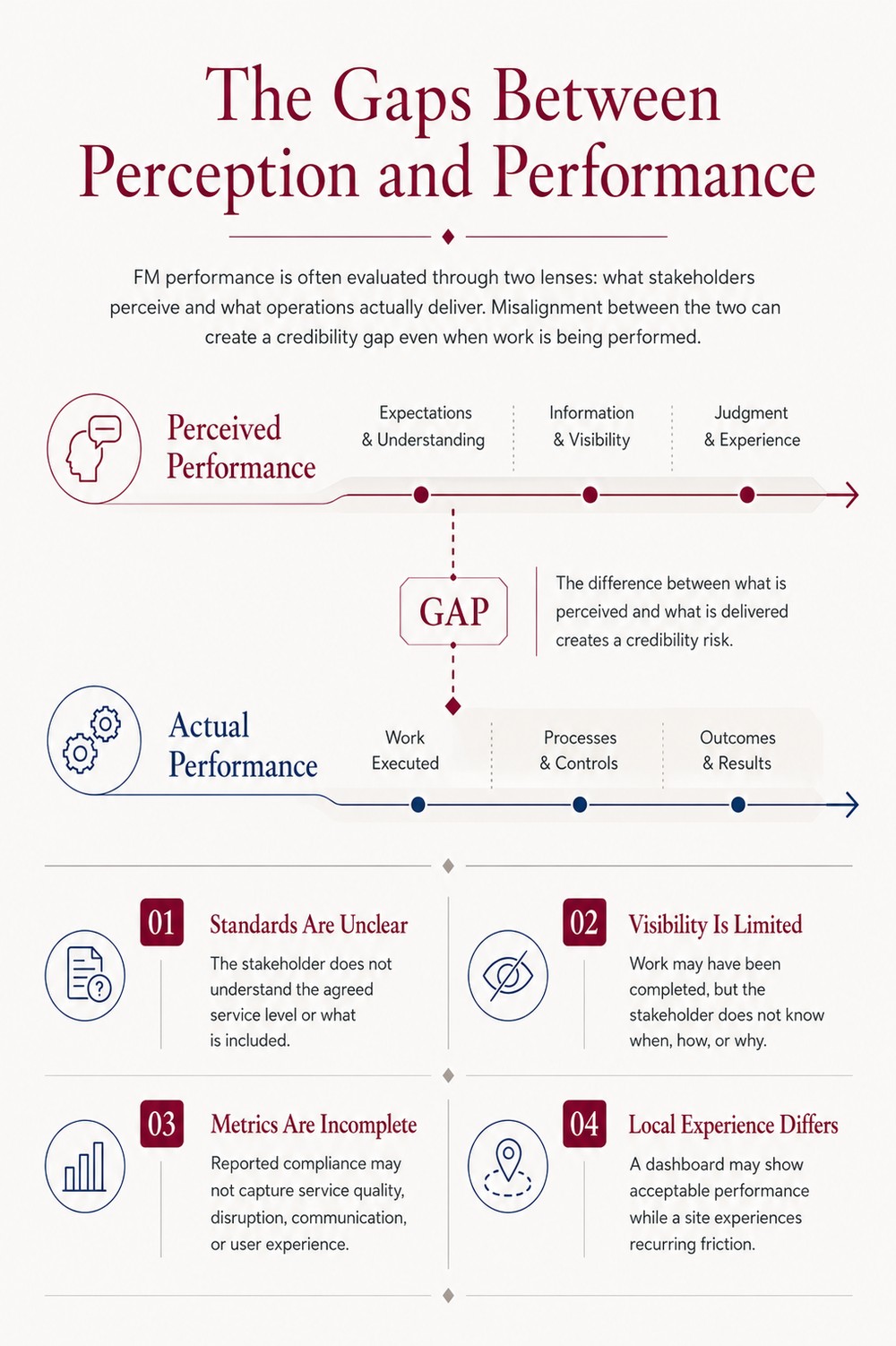
More reporting does not automatically solve this problem. Reports should support understanding, not simply document activity. Digital tools and dashboards are useful when they clarify the facts, support productive conversations, and enable better decisions. They are far less useful when they are used as substitutes for real human engagement.
A stronger response includes listening sessions with key stakeholders, brief follow-ups after incidents or service interruptions, periodic calibration reviews, and clear communication standards for work completion, delays, access constraints, and exceptions.
Service provider leaders also need the judgment and communication skills to handle stakeholder concerns well. Technical competence is necessary, but not sufficient. Account and site leaders must be able to listen, explain, reassure, and respond without becoming defensive.
3. The client lacks confidence in the provider.
Lack of confidence is often the hardest issue to resolve because it involves facts, history, risk perception, and emotion. It can appear as excessive client control, reluctance to delegate, reliance on backup vendors, resistance to process change, or continued escalation around routine matters.
It becomes particularly destructive when the parties stop giving each other’s concerns legitimacy. The client’s concerns may be dismissed as unfair or unreasonable, while the provider’s explanations may be written off as excuses or a lack of commitment. Once that dynamic takes hold, both parties become more focused on defending their position than understanding what needs to change.
Confidence issues are often change-management issues. They may reflect prior negative experiences, fear of business disruption, concern about loss of control, or uncertainty about whether the provider understands the client’s operating environment.
A stronger response includes:
- Stakeholder mapping: Identify champions, neutral stakeholders, skeptics, and potential blockers.
- Critical process walkthroughs: Review high-risk workflows, handoffs, escalation points, and failure scenarios with both client and provider teams.
- Senior sponsor alignment: Ensure visible support from client and provider leadership.
- Early wins: Demonstrate reliability through visible improvements in targeted areas.
- Transparent follow-through: Close the loop on commitments, especially when concerns have been raised repeatedly.
The Operational Responsibility Matrix is an FM-focused RACI that defines who is responsible, accountable, consulted, and informed for key activities, decisions, handoffs, approvals, and escalation points across the client, provider, and subcontractor teams. It remains one of the most useful tools for this work, but it should not be treated as a static appendix. When created collaboratively, the ORM clarifies authority, decision rights, retained client responsibilities, provider responsibilities, subcontractor interfaces, escalation paths, and transition boundaries.
The process of building the ORM is often as valuable as the final document. It exposes assumptions that may otherwise remain hidden until a service problem occurs.
Business relationship management.
Business relationship management is the practice of maintaining a working relationship under normal operating pressure. It is not the same as personal friendliness. Client and provider leaders do not need to be close personally, but they do need to operate with clarity, respect, responsiveness, and a shared commitment to solving business problems.
Neither party should confuse a pleasant personal relationship with an effectively managed business relationship. Lunches, informal check-ins, and personal rapport can be useful, but they cannot carry the weight of unresolved business concerns. In fact, relying on personal goodwill while avoiding direct conversations about performance, expectations, risk, or commercial realities can weaken the relationship over time.
Mutual responsibility is central. The service provider must deliver quality, communicate clearly, anticipate issues, and take initiative. The client must define expectations, make timely decisions, align internal stakeholders, address retained responsibilities, and treat the provider as an accountable service partner rather than a task-taker.
A healthy relationship also requires clarity about stakeholder roles. Executive sponsors, CRE and FM leaders, procurement, finance, risk and compliance, site leaders, business-unit customers, and front-line teams may all experience the relationship differently. Relationship management should recognize those differences rather than assume that a single set of metrics or a single operating meeting will meet every need.
Relationship management diagnostic.
The following questions can help diagnose whether the client and service provider are managing the outsourcing relationship effectively.
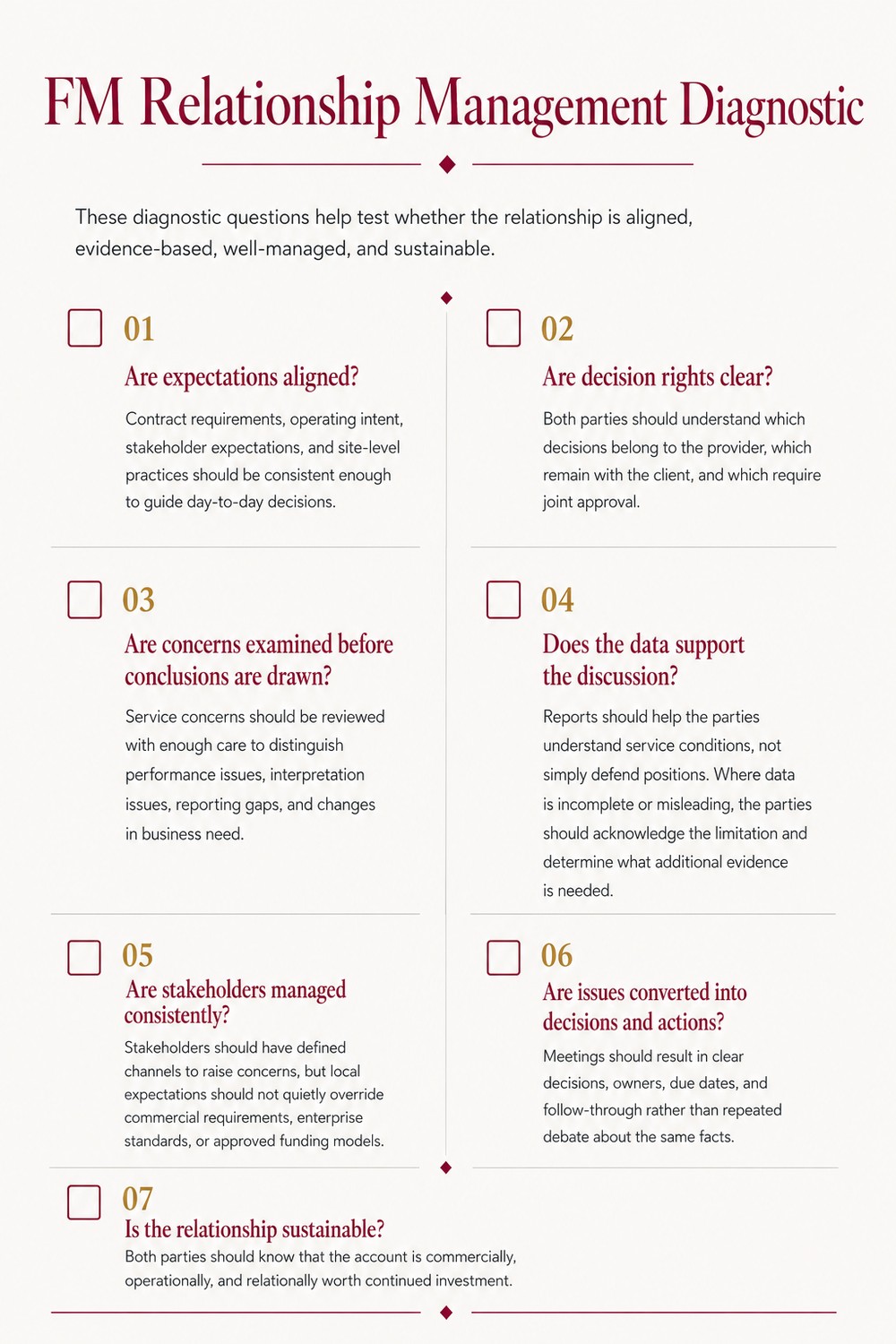
This checklist shifts relationship management from informal sentiment to observable practice. Effective relationships are marked by clear expectations, structured fact-finding, consistent stakeholder management, and visible closure of decisions and actions.
Relationship management practices that support performance.
Relationship health should be managed deliberately. It should not depend solely on informal rapport between the client lead and the provider account leader, nor be reduced to meetings, dashboards, or escalation protocols. The working relationship needs practical routines that help both parties align expectations, understand facts, make decisions, and close actions.
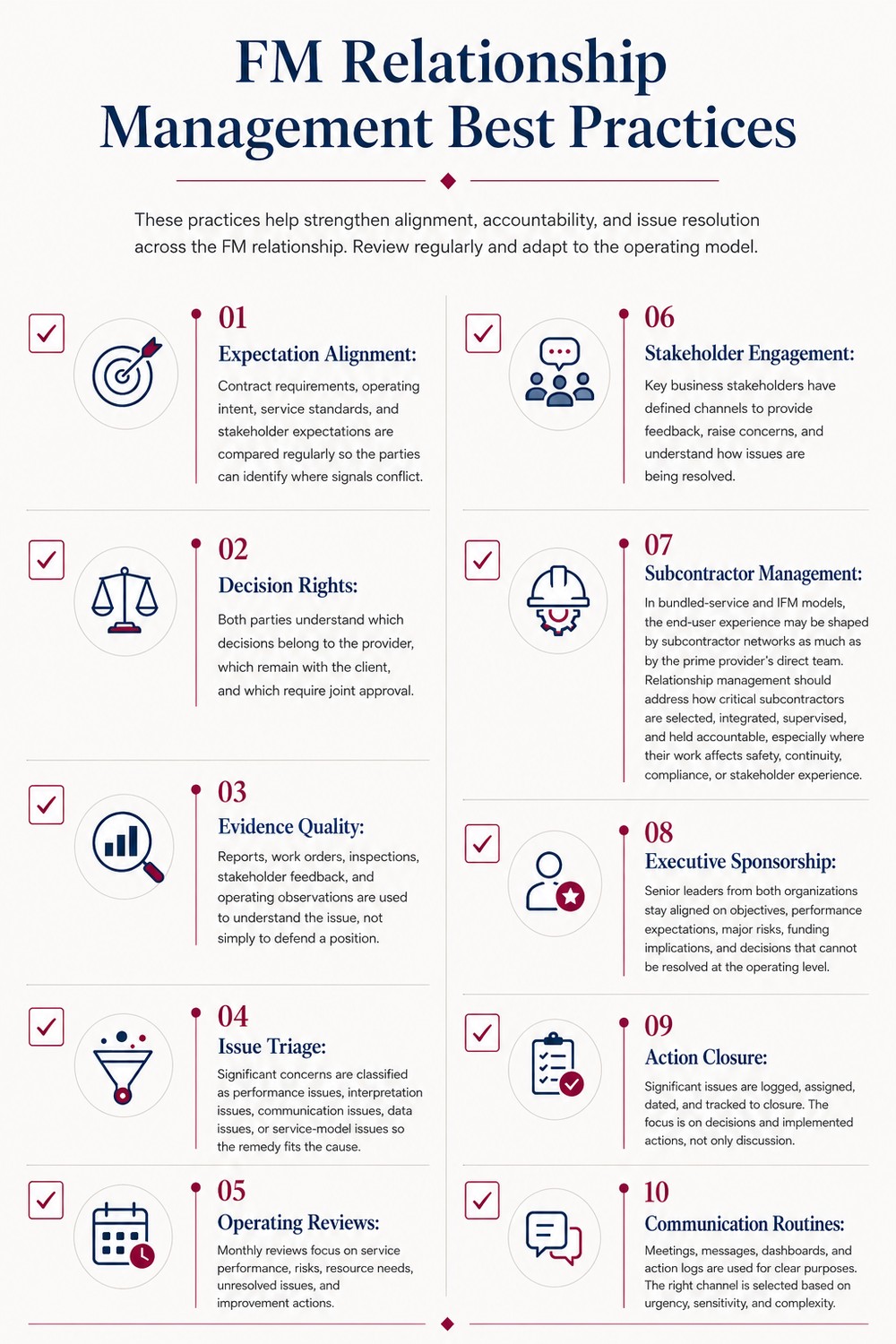
This relationship management model helps prevent the working relationship from becoming reactive. It gives both parties a structured way to move from concern to facts, to decision, to action. The purpose is to reduce time spent debating the data and increase time spent agreeing on what should change.
When relationships are struggling, an independent review or facilitated workshop can help. The purpose should be to identify the real sources of friction, test whether the available data supports the competing views, clarify decision rights, and rebuild confidence through practical commitments.
The behaviors that hold the relationship together.
The practices described above create a useful structure for the relationship. They help the parties align expectations, examine facts, make decisions, engage stakeholders, and close actions. But no relationship-management model works perfectly on its own.
Operating conditions change. Data may be incomplete. Contract language may not anticipate every business need. Meeting routines may surface an issue without fully resolving it. In those moments, the quality of the relationship depends on how the parties behave while they work through the gap.
These five behaviors will make relationship management work in daily practice, help bridge occasional imperfections in the model, and maintain confidence while issues are being clarified and resolved.
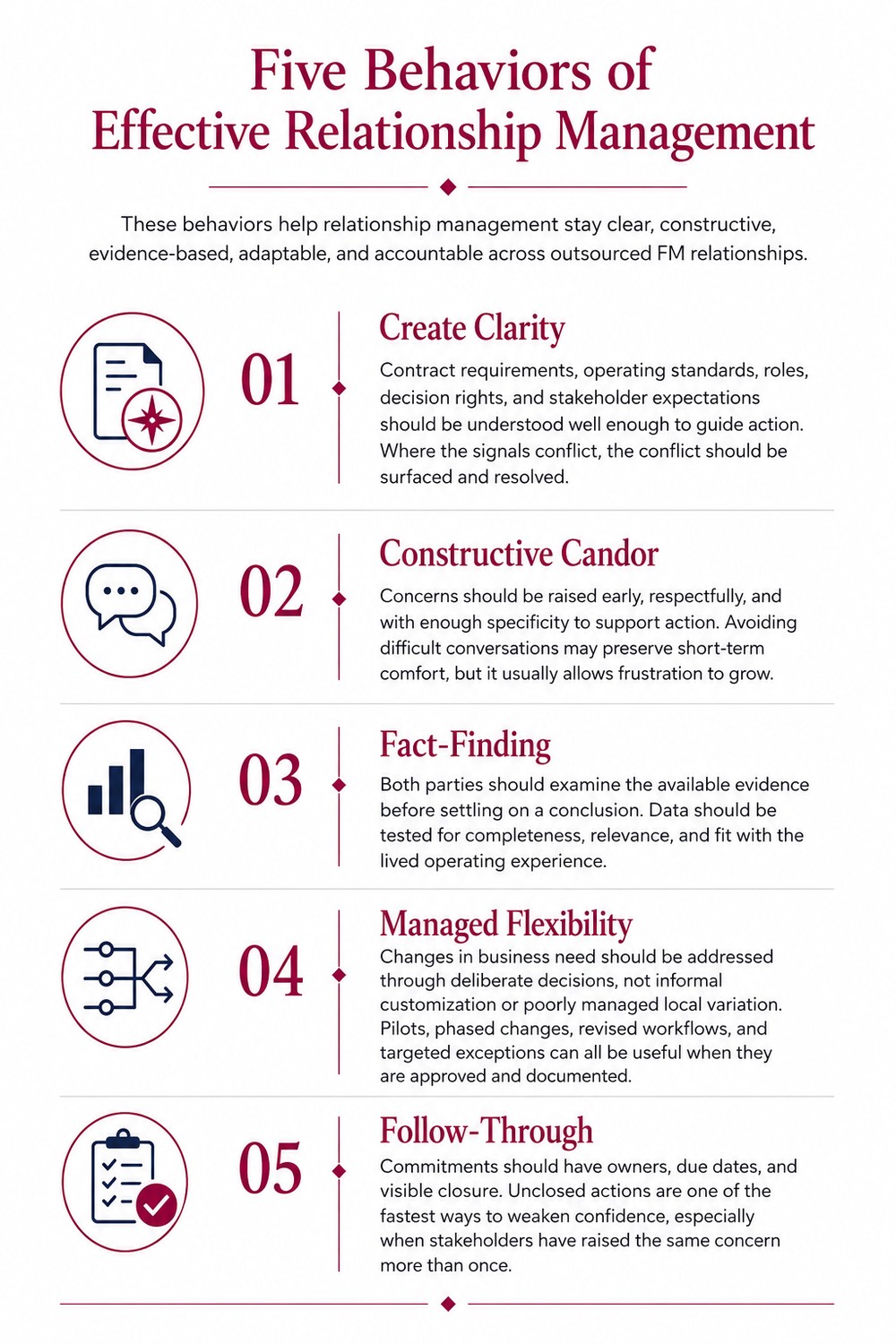
Trust is the result of these behaviors. It grows when the parties are clear, candid, fact-based, flexible within agreed boundaries, and reliable in closing commitments.
Conclusion.
High-performing FM outsourcing is achievable when the client and service provider manage the relationship as a shared operating system, not only as a contract. Service levels, metrics, reports, and tools all matter. However, long-term performance depends on whether people can communicate honestly, make decisions, resolve issues, and maintain confidence under pressure.
Effective relationships are not those with the most dashboards or the most pleasant lunches. They are the ones where expectations are clear, issues are surfaced early, facts are understood, decisions are made, actions are closed, and both parties remain committed to the business outcomes for which the outsourcing relationship was created.
Dashboards and contracts can support the relationship, but they cannot substitute for clarity, candor, and follow-through. When the relationship is managed well, outsourcing becomes more than delegated work. It becomes a platform for operational reliability, stakeholder confidence, and a more satisfying work environment for both client and provider teams. The account performs better because the people responsible for the work are better able to understand each other, solve problems, and take pride in the results.