
Facility management has received increased attention at the company board level. Considerations such as operational reliability, ESG goals, building performance, digital systems, and hybrid work have made the workplace a key asset. Boards and executive teams at headquarters, campuses, hospitals, and research centers now discuss FM topics in their meetings. The most successful FM organizations are led by people who address these issues in business terms.
Talking with the C-Suite takes a different set of skills than running daily operations. Both matter, but this article focuses on how to communicate effectively with executives.
Talk about the business, not the facilities.
Understandably, FM leaders characteristically begin C-Suite conversations by discussing what they know best: facility details. But executives are not interested in work order numbers, equipment age, backlog metrics, or vendor scorecards. These details are important for your team, but they usually do not need executive attention.
The C-Suite cares about how facilities affect reputation, risk, costs, talent, compliance, and other key business issues. At corporate headquarters, they focus on client experience and employee retention. On university campuses, it’s about student experience, faculty hiring, and donor engagement. In hospitals or research centers, it’s about patient safety, regulatory compliance, and keeping programs running. FM communications should focus on these topics and leave out most operational details.
Don’t start with technical metrics or maintenance terms that need explanation. Executives care less about backlog size and more about what happens if action is delayed and what trade-offs are involved. For example:
“We have a 90-day window to address a growing risk to building comfort and reliability. Doing so will require an additional $2.3 million in vendor support, which we recommend funding. If we defer the work, the likely cost of disruption is approximately four times higher and could affect client-facing operations, major campus events, and the organization’s reputation. A failure during a high-profile visit, commencement, or a period of peak clinical demand would have significant visibility. I plan to ensure leadership is aware of the risk prior to moving forward.”
The facts stay the same, but the conversation shifts.
Master the three Rs.
FM leaders usually talk with the C-Suite in three ways, and each needs a different approach.
Reporting results
The most important thing is to express results against commitments and business requirements. Be crisp, use data, and remain composed and factual. At headquarters, campuses, hospitals, or research centers, this often includes:
- Comfort and uptime in key spaces (executive floors, classrooms, labs, patient areas)
- Satisfaction scores from employees, students, clinicians, or researchers
- Safety and incident performance
- Space utilization and conformity with how people are actually using the portfolio
- Budget performance and avoided costs
Point out where you met or missed your goals and briefly explain. The C-Suite wants honesty and clear plans for improvement. In practice, this might sound like:
“We intend to maintain 95%+ satisfaction with the workplace and learning environment in our core buildings and achieved 96% overall. We are below target in two high-density areas; here is what we are piloting there this semester and the impact we expect over the next two quarters.”
Revealing opportunities
This is about telling the board what’s coming up and what they should know. In different sectors, these often look like:
- Real estate consolidation that takes advantage of hybrid work while protecting client-facing, student-facing, or patient-facing presence
- Energy and sustainability investments with strong returns that also enhance community perception and regulatory positioning
- Space redesign to support new ways of working, new teaching models, new clinical pathways, or new research programs
- Building upgrades that reduce long-term operating risk as well as enhance the brand or mission experience
These discussions should focus on the future. Share options, explain the trade-offs, and give your recommendation, backed by your well-researched reasons. For example:
“We can reduce our overall footprint by 15–20% over three years while upgrading space quality for our senior teams, students, and key partners. Option A maximizes near-term cost savings; Option B preserves more flexibility in our flagship academic and client-facing buildings. My recommendation is Option B because it protects our brand, our student and visitor experience, and our ability to host major events on-site.”
Requesting investments
This is when you request funding or approval. Begin with the business case and the risks of inaction, not just the cost. While the CFO will focus on cost, others need to understand the business rationale first. Instead of “We need $10 million for building upgrades,” start with the business outcome:
“We can significantly reduce guest and patient complaints, protect our ability to host major events, ensure continuity of research and clinical operations, and bring our flagship facilities in line with our public sustainability targets. Doing so requires a one-time capital program of $10 million over two years, with a three-year payback and clear reputational and regulatory risk reduction if we act now versus defer.”
Each of the three Rs is a key skill. Senior FM leaders who struggle to communicate with the C-Suite often need to improve in one of these areas.
Stay out of the weeds.
Save detailed operational data for operations reviews, not C-Suite meetings. Only share details if the board has flagged a specific risk or if an important indicator needs to be explained.
You might want to share lots of operational details, especially if FM does not present often. Don’t do this. The C-Suite values leaders who are concise. Too much detail can make them lose interest.
Focus on the information the executive needs. For example, if the board is considering modernizing a facility, they do not need last year’s actuator failure count. They need to know the number of key events hosted, the current experience and risks, and the benefits of investing now versus later.
Anticipate the needs and the questions.
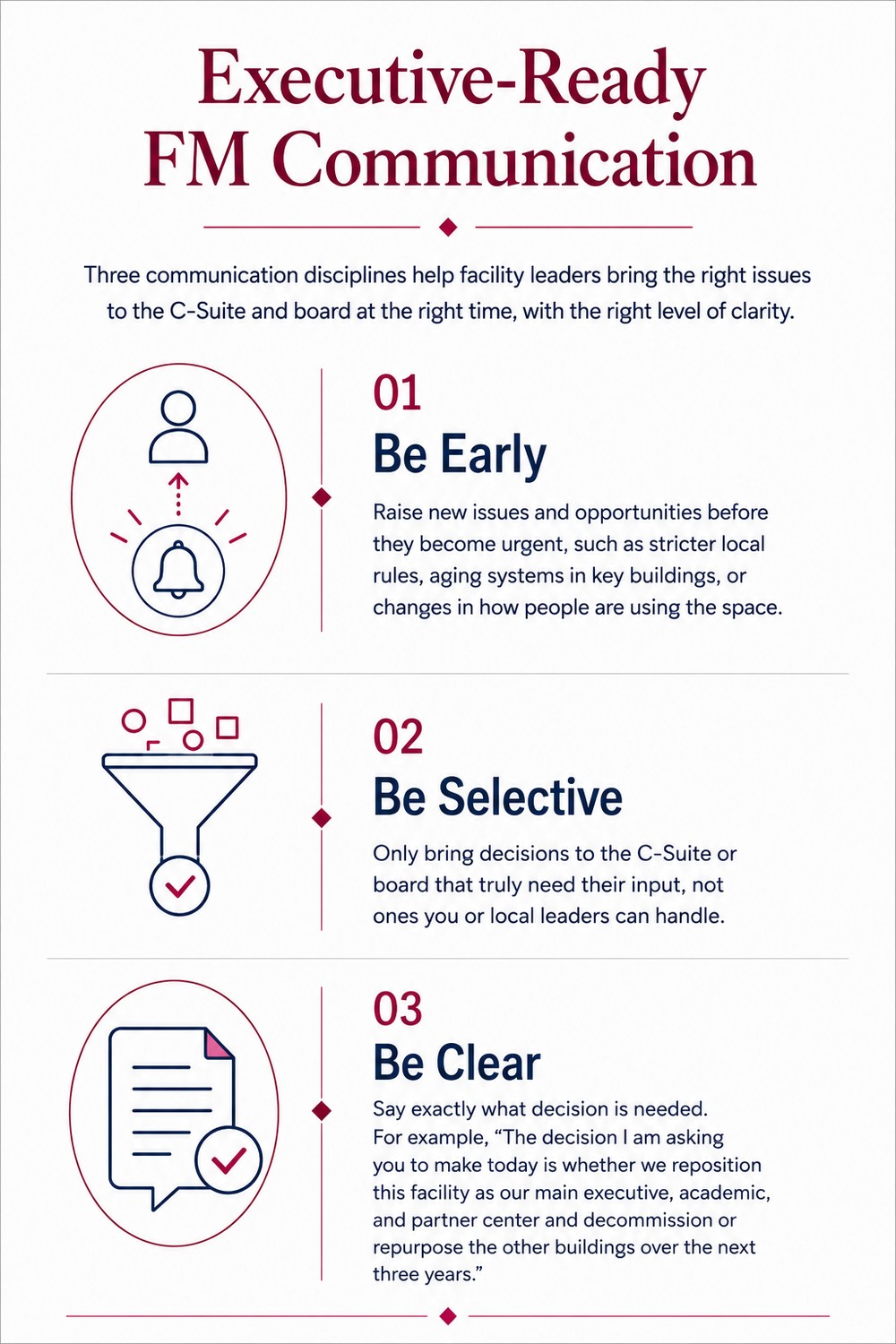
Effective FM leaders do not come to the C-Suite or board with problems looking for solutions. They bring the issue early enough to matter, narrow the discussion to decisions that genuinely require senior input, and state clearly what they are asking leadership to decide.
This preparation matters because executives are not looking for every operational detail first. They need to understand why the issue matters, what options are available, what trade-offs are involved, and where their judgment or authority is needed. When FM communication anticipates those questions, the conversation moves faster, and leadership confidence increases.
In practice, executive-ready FM communication depends on three habits: be early, be selective, and be clear.
Crisis communication is the moment of truth.
FM crises test both operational readiness and executive confidence. Events such as fires, floods, power outages, security issues, system failures, or other disruptions quickly draw C-Suite attention because they can affect safety, business continuity, reputation, and stakeholder trust.
In those moments, senior leaders do not need every technical detail before they hear from FM. They need a timely understanding of what happened, who or what is affected, what is being done, what remains uncertain, and when the next update will arrive.
Effective FM crisis communication should therefore be fast, structured, factual, and centered on organizational impact. In practice, four habits matter most: communicate early, establish a cadence, separate facts from interpretations, and lead with impact.
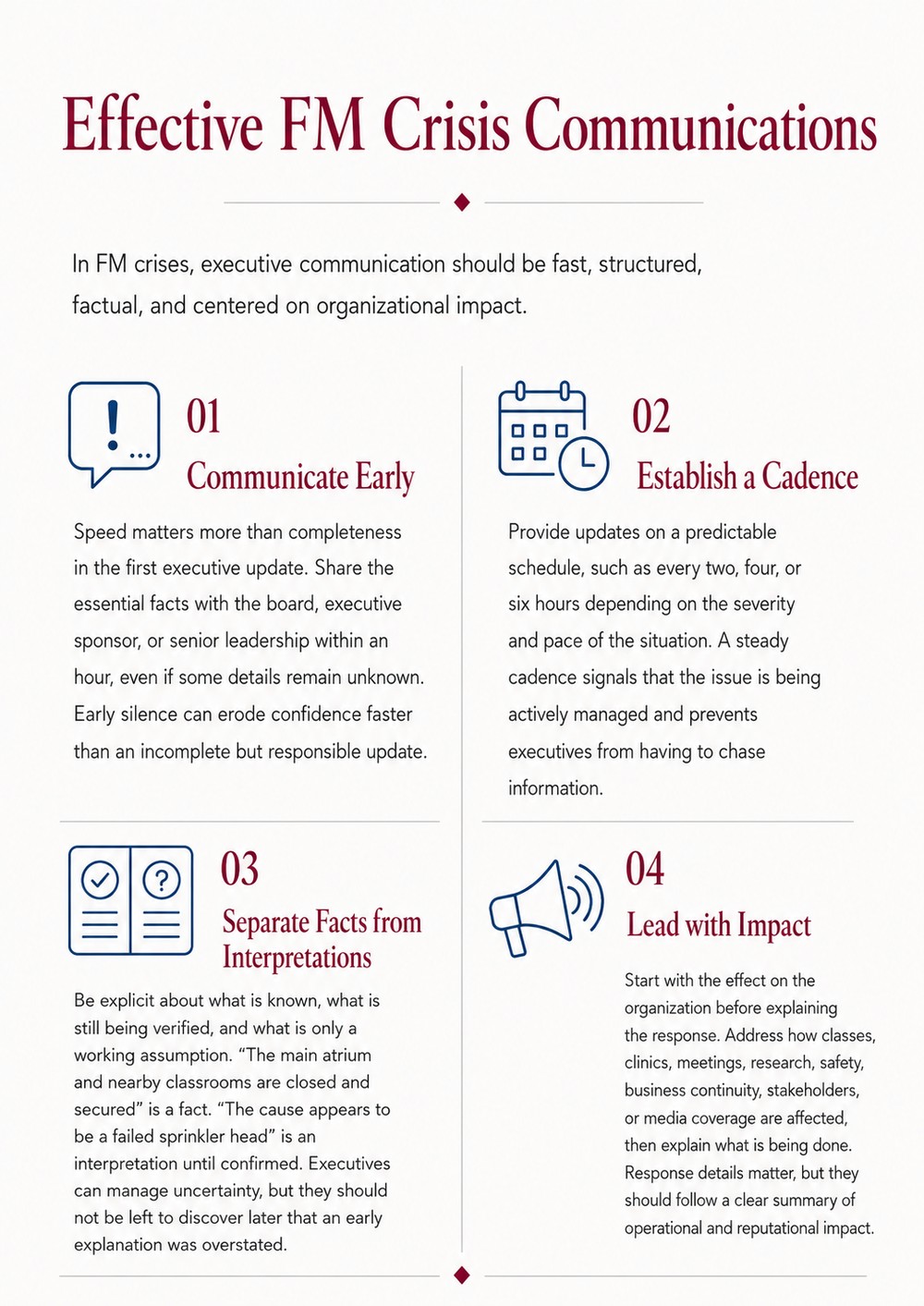
Each crisis update must follow a clear structure: what happened, the impact on the business or institution, the ensuing steps, and the timing of the next update.
A closing thought.
The FM leader’s role is increasingly strategic. While your communication skills may not have kept pace, they can absolutely be developed. Every senior FM leader I have worked with who has committed to improving C-Suite communication has demonstrated significant, positively career-impacting progress within a year. Recognize this skill as part of your role; a little intentional effort will make your communications much more impactful and credible.